An ontology describes the rules. A harness makes them stick.
OntologicalHarness is the governed scaffold an agent runs inside. It gives the agent meaning, constraints, authority and a path to act, so agents and humans work under one framework with full auditability, learning and insight.
- Same rules for agents and humans
- Same approvals
- Same audit trail
Enable your AI agents the way you enable your people
You onboard a person with a role, clear rules, approvals and a manager who can see what they did. Most agents get a prompt and a credential. That leaves two problems.
Agents and people run under different rules
Agents act with broad access and no shared definition of the business. People work under policy and approvals. Two rulebooks means gaps nobody can audit, and nothing either one does teaches the other.
One framework for both
The harness gives agents and humans the same meaning, rules, roles and approvals. Every action is checked and logged the same way, so you get full auditability, a record to learn from, and insight into what is working.
Every action on the record
Who or what acted, which rule applied, who approved it.
Overrides become better rules
Near misses and overrides turn into proposed changes a steward reviews.
See how work really runs
Compare agent and human outcomes under the same rules.
Agents and humans follow the same rules
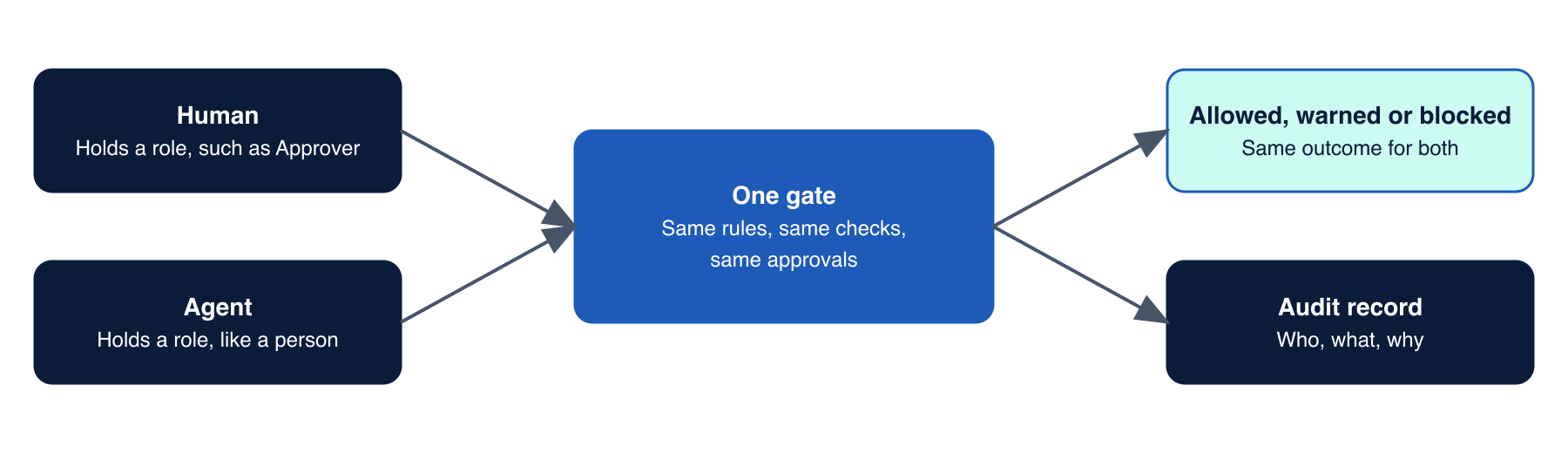
An agent does not get a side door. It holds a role, it hits the same checks, it needs the same approvals and it leaves the same record as a person doing the same job. The only difference between them is the role they hold.
One set of rules
A BLOCK rule stops a person and an agent alike. A WARN flags both. Nobody writes a second rulebook for software.
No self approval
If a spend over the limit needs a manager, it needs one whether the request came from a person or an agent.
One audit trail
Every request, check, approval and outcome is recorded the same way, so an auditor reads one story, not two.
Agents are moving faster than the controls around them
Most teams can build an agent. Far fewer can say what it is allowed to do, stop it when it should not, and show an auditor what happened.
of 3,235 leaders surveyed by Deloitte (2026) reported a mature model for agent governance.
in the same research lacked clear boundaries, monitoring or audit trails for agent actions.
could not enforce purpose limits on their agents, in a Kiteworks survey (n=225). It is a vendor survey, so read it as a signal, not a census.
Four things a model cannot supply for itself
Meaning
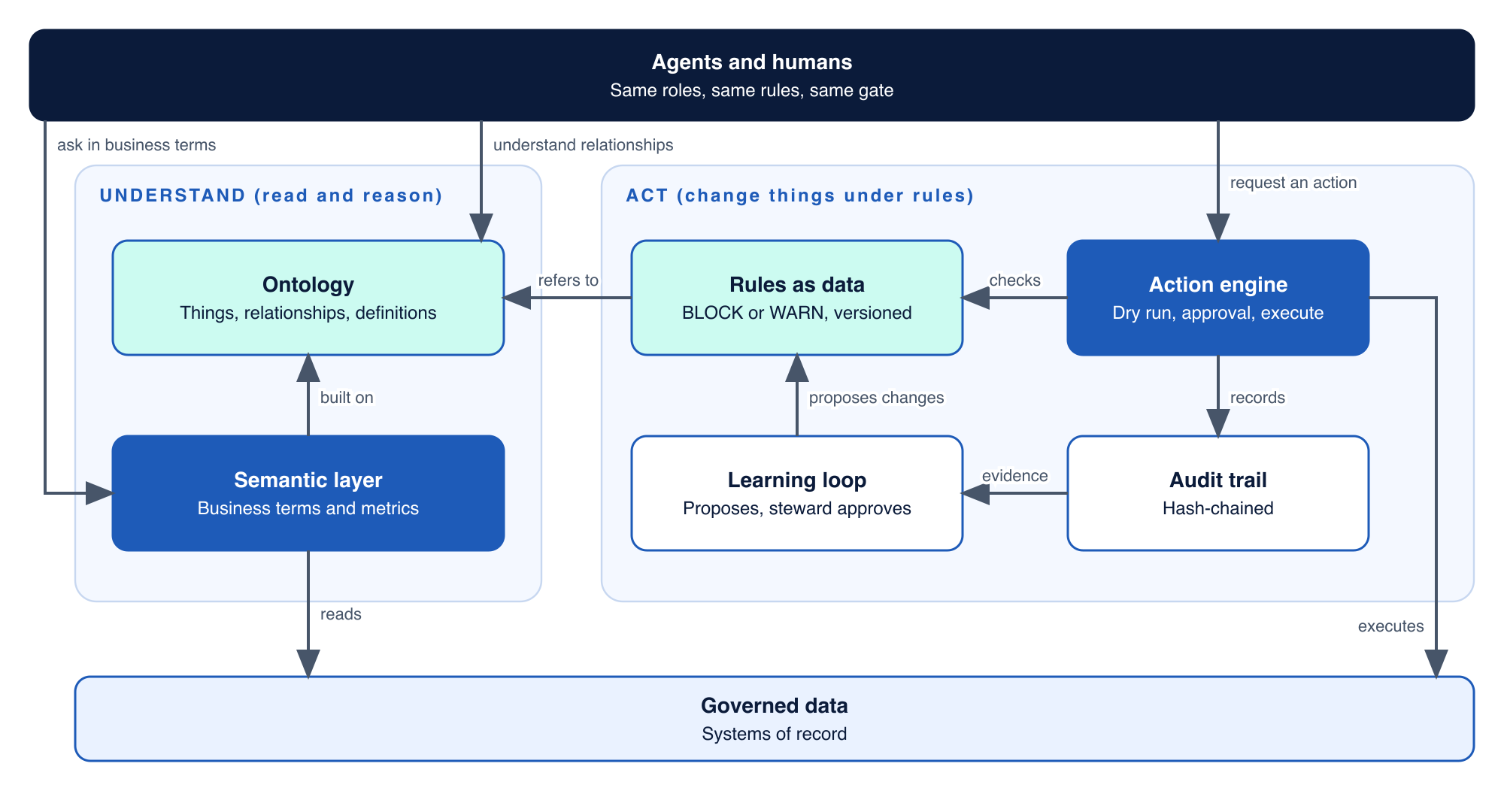
An ontology says what things are and how they relate, in terms the business uses.
Constraints
Rules live as data. BLOCK stops an action. WARN flags it. Each has an owner, a version and a reason.
Authority
Agents hold roles like people do. Revoke the role and the agent stops.
A path
Dry run, precondition checks, approval, execution, audit. One controlled route to change anything.
Observe, understand, decide, act, confirm, learn
The loop runs the same way whether a person or an agent is driving. Learning proposes rule changes and cites its evidence. A steward approves. The agent never approves its own change.

Four jobs, one boundary
Ground agents
Give agents shared definitions and live context so they stop guessing at what a term means.
Automate workflows
Let agents take real actions inside limits you can read, test and change.
Learn continuously
Turn overrides and near misses into proposed rule changes that people review.
Audit everything
Every request, check, approval and outcome is recorded in a tamper-evident chain.
Put a boundary around what your agents can do
We are onboarding a small group of early access teams. Tell us what you want to ground, automate or audit.
Request early access